

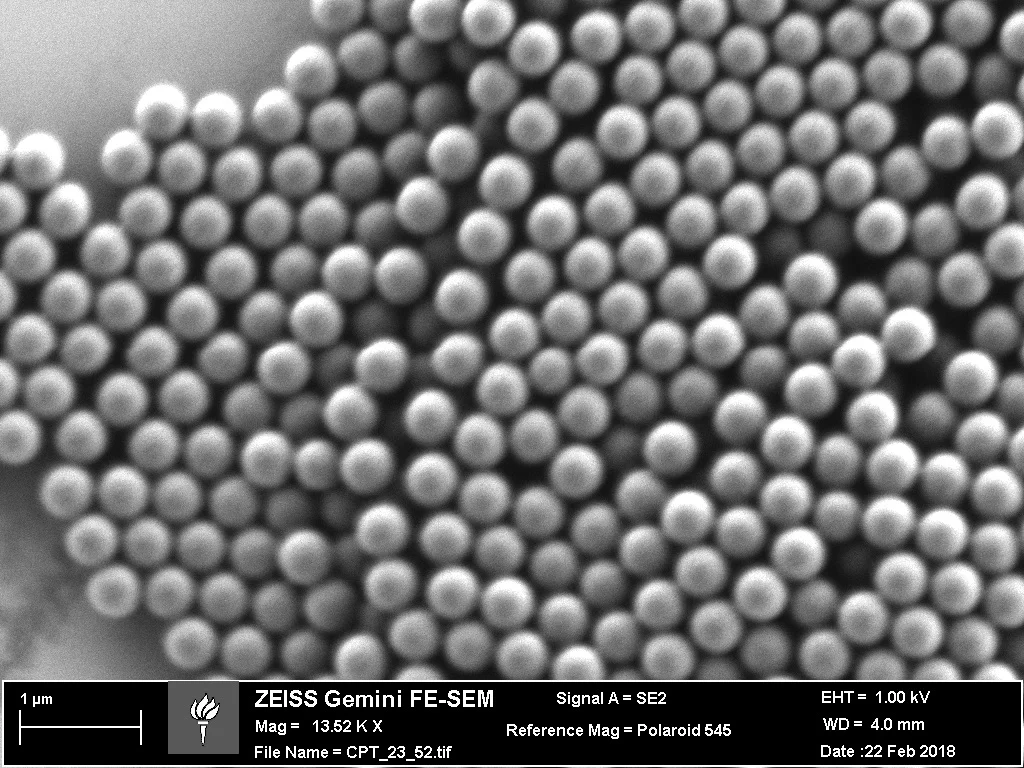
Sample Name: IP-01-15-CPT_23
Description : Positive PS particles manufactured using surfactant-free emulsion polymerization.
Characteristics:
Diameter: 460 nm
ζ-potential: +34.1 mV
Recipe:
- An alumina column stoppered with cotton was used to remove inhibitor from the packaged styrene monomer. The filtered styrene monomer was refrigerated at 4 ℃ until ready to use.
- 350 mL of deionized water (by weight) was added into a 1000 mL triple-neck round-bottom flask.
- The round-bottom flask was then submerged into a silicone oil bath placed above a heating plate, where a mechanical stirrer and a condenser were attached to the flask.
- 35 mL of filtered styrene monomer were pipetted into the round-bottom flask, sealing the system with a rubber stopper.
- Mechanical stirring was engaged at 330 rpm, and the system was purged with high-purity nitrogen for approximately 30 minutes while the heating plate raised the temperature of the flask to 60 ℃, where it would remain for the duration of the polymerization.
- 350 mg of 2,2′-azobis(2-methylpropionamidine) dihydrochloride (AIBA) were dissolved in 5 mL of deionized water, and added into the sealed system using a syringe.
- The polymerization was allowed to proceed for 18-20 hours, at which point the system was opened and heated to 90 ℃ for 90 minutes to evaporate unreacted monomer, and then allowed to cool all while stirring.
- The remaining radical initiator was cleaned out with three cycles of repeated centrifugation and resuspension in deionized water.
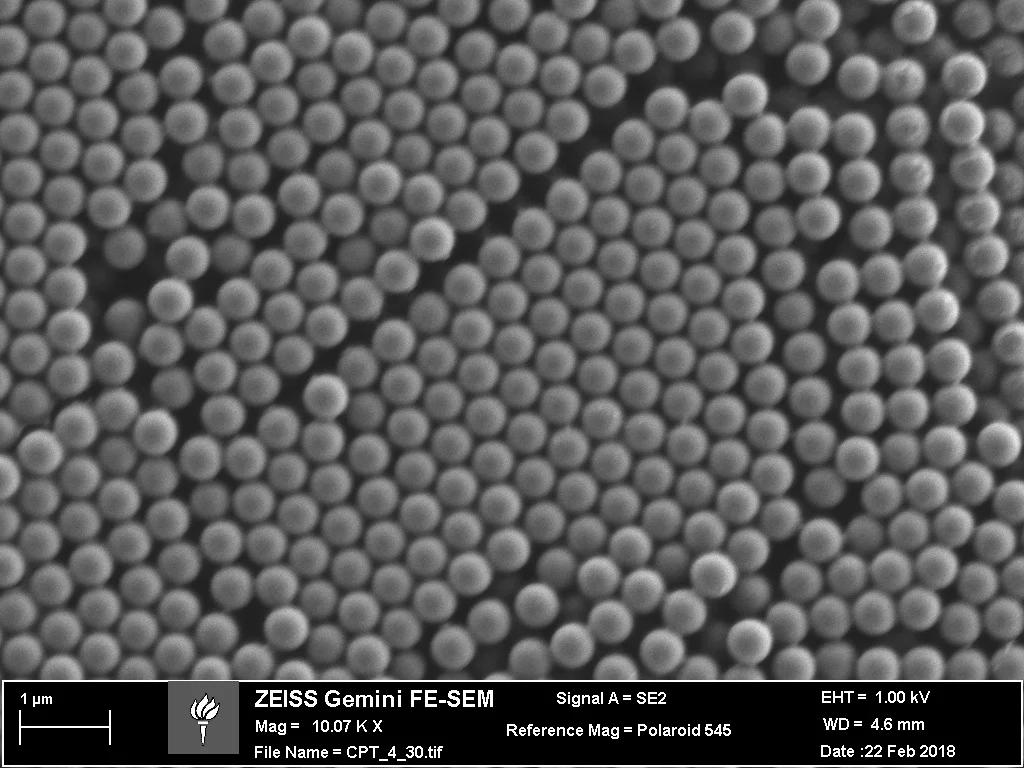
Sample Name: IP-01-15-CPT_4
Description : Positive PS particles manufactured using surfactant-free emulsion polymerization.
Characteristics:
Diameter: 490 nm
ζ-potential: +29.6 mV
Recipe:
- An alumina column stoppered with cotton was used to remove inhibitor from the packaged styrene monomer. The filtered styrene monomer was refrigerated at 4 ℃ until ready to use.
- 350 mL of deionized water (by weight) was added into a 1000 mL triple-neck round-bottom flask.
- The round-bottom flask was then submerged into a silicone oil bath placed above a heating plate, where a mechanical stirrer and a condenser were attached to the flask.
- 35 mL of filtered styrene monomer were pipetted into the round-bottom flask, sealing the system with a rubber stopper.
- Mechanical stirring was engaged at 330 rpm, and the system was purged with high-purity nitrogen for approximately 30 minutes while the heating plate raised the temperature of the flask to 60 ℃, where it would remain for the duration of the polymerization.
- 450 mg of 2,2′-azobis(2-methylpropionamidine) dihydrochloride (AIBA) were dissolved in 5 mL of deionized water, and added into the sealed system using a syringe.
- The polymerization was allowed to proceed for 18-20 hours, at which point the system was opened and heated to 90 ℃ for 90 minutes to evaporate unreacted monomer, and then allowed to cool all while stirring.
- The remaining radical initiator was cleaned out with three cycles of repeated centrifugation and resuspension in deionized water.
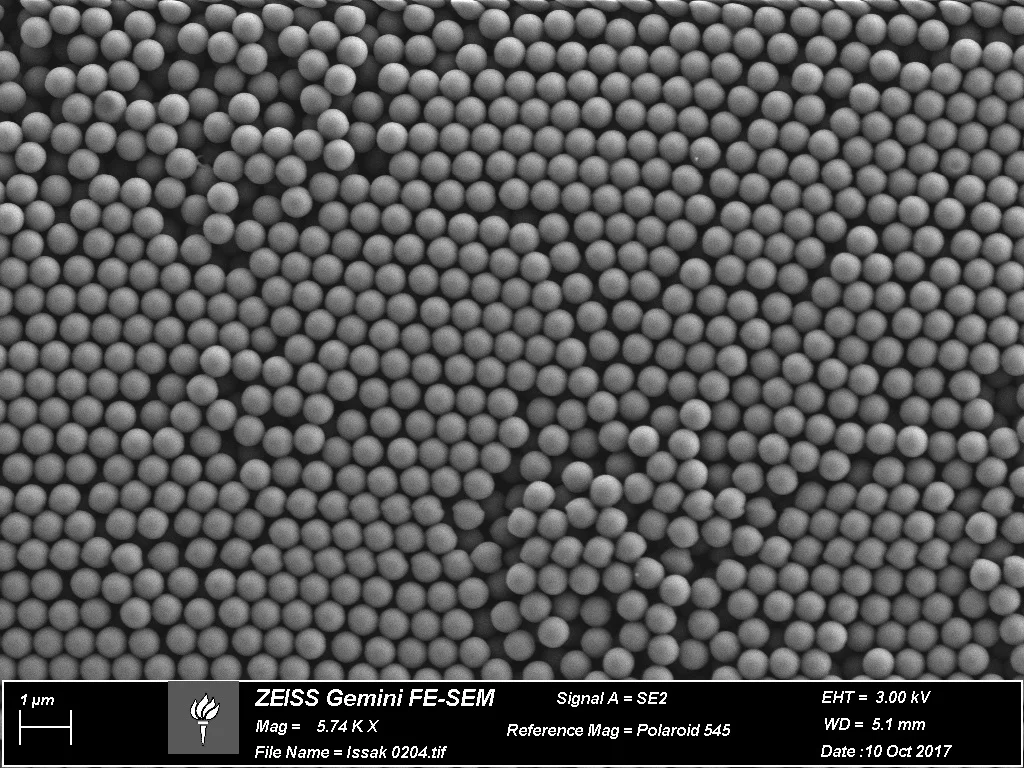
Sample Name: IP-01-15-CPT_2, IP-01-15-CPT_7
Description : Positive PS particles manufactured using surfactant-free emulsion polymerization.
Characteristics:
Diameter: 500 nm
ζ-potential: +41.6 mV, +33.8 mV
Recipe:
- An alumina column stoppered with cotton was used to remove inhibitor from the packaged styrene monomer. The filtered styrene monomer was refrigerated at 4 ℃ until ready to use.
- 350 mL of deionized water (by weight) was added into a 1000 mL triple-neck round-bottom flask.
- The round-bottom flask was then submerged into a silicone oil bath placed above a heating plate, where a mechanical stirrer and a condenser were attached to the flask.
- 35 mL of filtered styrene monomer were pipetted into the round-bottom flask, sealing the system with a rubber stopper.
- Mechanical stirring was engaged at 330 rpm, and the system was purged with high-purity nitrogen for approximately 30 minutes while the heating plate raised the temperature of the flask to 60 ℃, where it would remain for the duration of the polymerization.
- 350 mg of 2,2′-azobis(2-methylpropionamidine) dihydrochloride (AIBA) were dissolved in 5 mL of deionized water, and added into the sealed system using a syringe.
- The polymerization was allowed to proceed for 18-20 hours, at which point the system was opened and heated to 90 ℃ for 90 minutes to evaporate unreacted monomer, and then allowed to cool all while stirring.
- The remaining radical initiator was cleaned out with three cycles of repeated centrifugation and resuspension in deionized water.
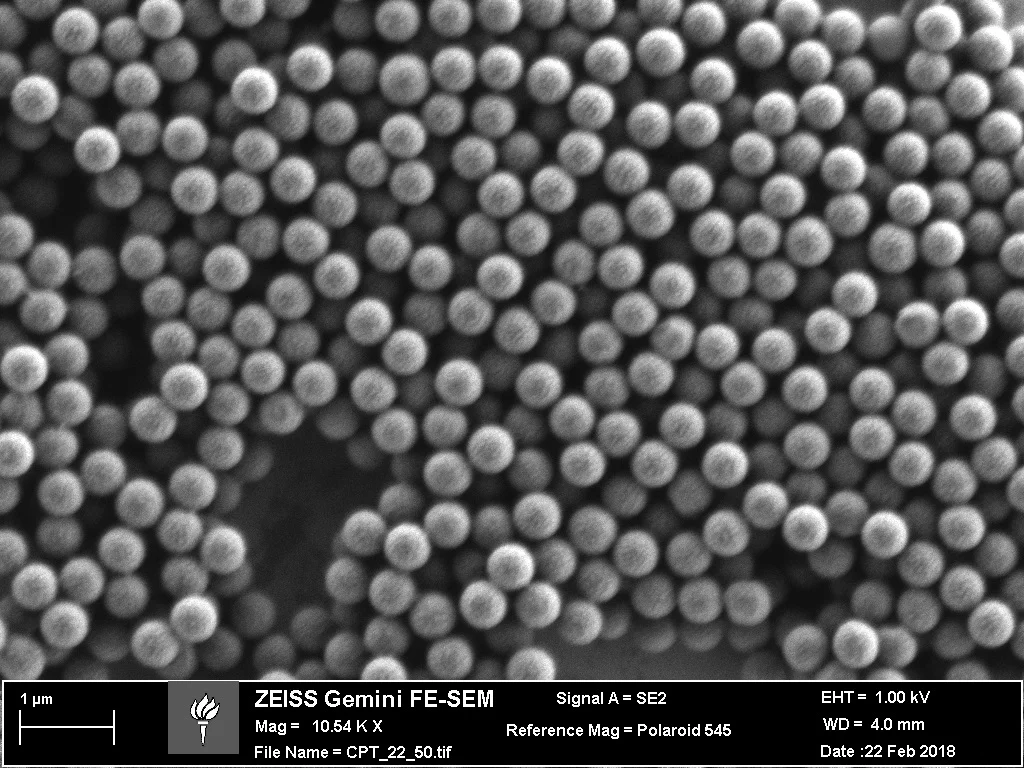
Sample Name: IP-01-15-CPT_22
Description : Negative PS particles manufactured using surfactant-free emulsion polymerization.
Characteristics:
Diameter: 500 nm
ζ-potential: -45.8 mV
Recipe:
An alumina column stoppered with cotton was used to remove inhibitor from the packaged styrene monomer. The filtered styrene monomer was refrigerated at 4 ℃ until ready to use.
350 mL of deionized water (by weight) was added into a 1000 mL triple-neck round-bottom flask.
The round-bottom flask was then submerged into a silicone oil bath placed above a heating plate, where a mechanical stirrer and a condenser were attached to the flask.
35 mL of filtered styrene monomer were pipetted into the round-bottom flask, sealing the system with a rubber stopper.
Mechanical stirring was engaged at 330 rpm, and the system was purged with high-purity nitrogen for approximately 30 minutes while the heating plate raised the temperature of the flask to 60 ℃, where it would remain for the duration of the polymerization.
350 mg of potassium peroxosulfate (KPS) were dissolved in 5 mL of deionized water, and added into the sealed system using a syringe.
The polymerization was allowed to proceed for 18-20 hours, at which point the system was opened and heated to 90 ℃ for 90 minutes to evaporate unreacted monomer, and then allowed to cool all while stirring.
The remaining radical initiator was cleaned out with three cycles of repeated centrifugation and resuspension in deionized water.
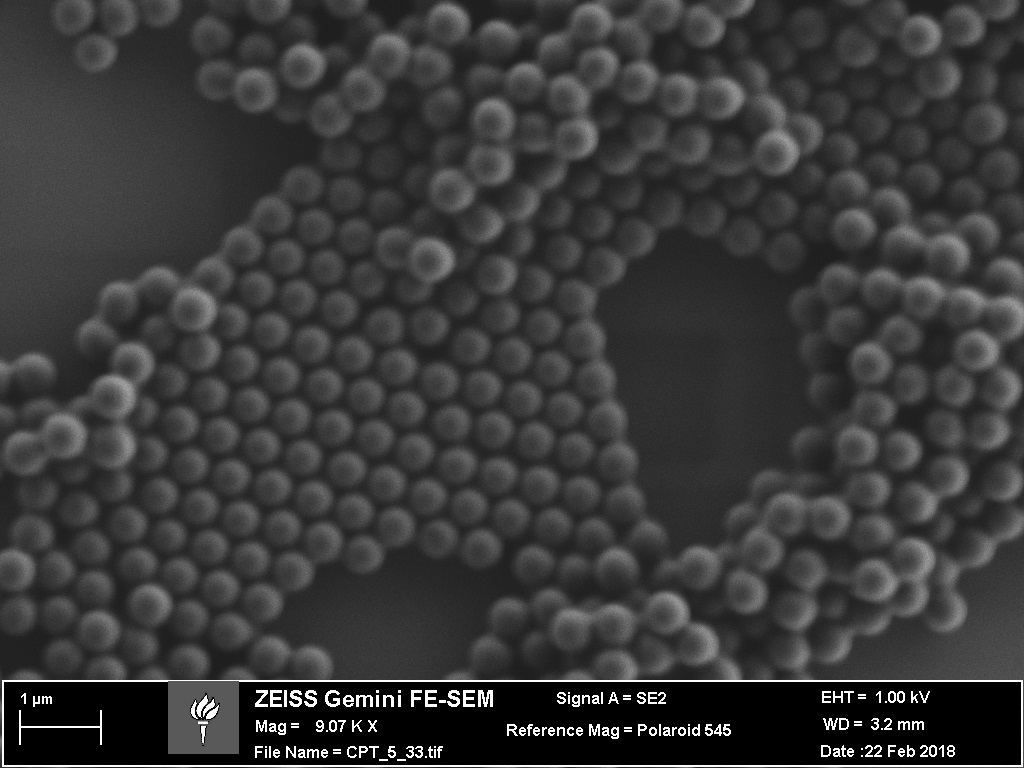
Sample Name: IP-01-15-CPT_5
Description : Positive PS particles manufactured using surfactant-free emulsion polymerization.
Characteristics:
Diameter: 520 nm
ζ-potential: +27.3 mV
Recipe:
- An alumina column stoppered with cotton was used to remove inhibitor from the packaged styrene monomer. The filtered styrene monomer was refrigerated at 4 ℃ until ready to use.
- 350 mL of deionized water (by weight) was added into a 1000 mL triple-neck round-bottom flask.
- The round-bottom flask was then submerged into a silicone oil bath placed above a heating plate, where a mechanical stirrer and a condenser were attached to the flask.
- 35 mL of filtered styrene monomer were pipetted into the round-bottom flask, sealing the system with a rubber stopper.
- Mechanical stirring was engaged at 330 rpm, and the system was purged with high-purity nitrogen for approximately 30 minutes while the heating plate raised the temperature of the flask to 60 ℃, where it would remain for the duration of the polymerization.
- 500 mg of 2,2′-azobis(2-methylpropionamidine) dihydrochloride (AIBA) were dissolved in 5 mL of deionized water, and added into the sealed system using a syringe.
- The polymerization was allowed to proceed for 18-20 hours, at which point the system was opened and heated to 90 ℃ for 90 minutes to evaporate unreacted monomer, and then allowed to cool all while stirring.
- The remaining radical initiator was cleaned out with three cycles of repeated centrifugation and resuspension in deionized water.

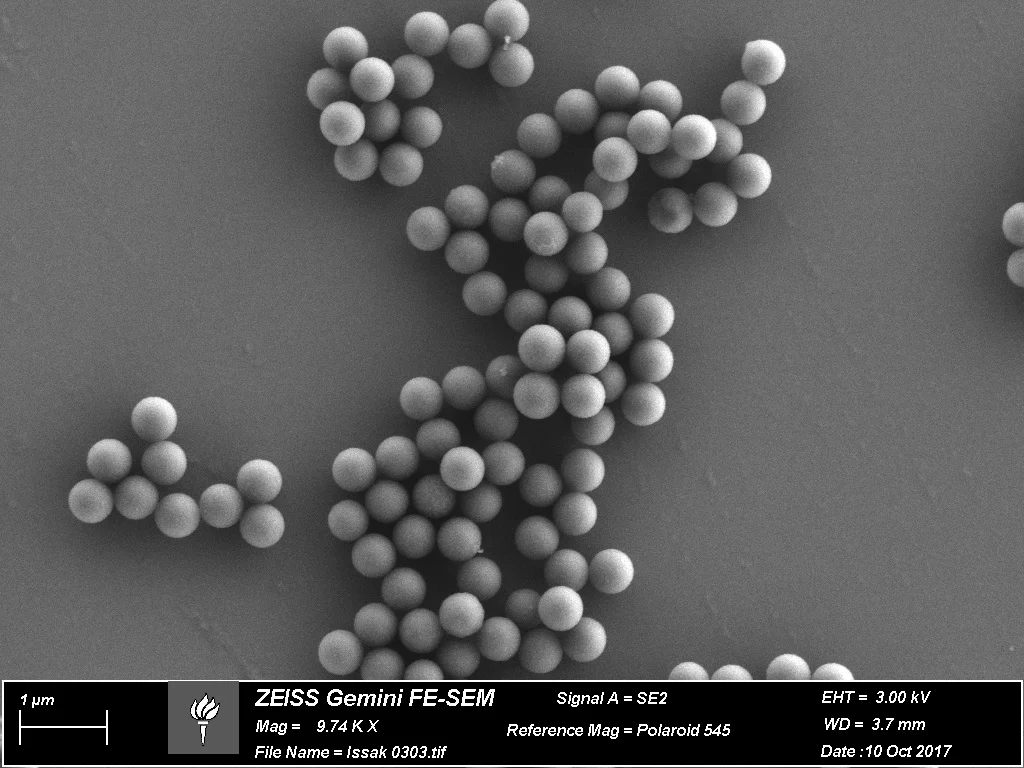
Sample Name: IP-01-15-CPT_16
Description : Negative PS particles manufactured using surfactant-free emulsion polymerization.
Characteristics:
Diameter: 530 nm
ζ-potential: -38.2 mV
Recipe:
An alumina column stoppered with cotton was used to remove inhibitor from the packaged styrene monomer. The filtered styrene monomer was refrigerated at 4 ℃ until ready to use.
350 mL of deionized water (by weight) was added into a 1000 mL triple-neck round-bottom flask.
The round-bottom flask was then submerged into a silicone oil bath placed above a heating plate, where a mechanical stirrer and a condenser were attached to the flask.
35 mL of filtered styrene monomer were pipetted into the round-bottom flask, sealing the system with a rubber stopper.
Mechanical stirring was engaged at 330 rpm, and the system was purged with high-purity nitrogen for approximately 30 minutes while the heating plate raised the temperature of the flask to 60 ℃, where it would remain for the duration of the polymerization.
350 mg of potassium peroxosulfate (KPS) were dissolved in 5 mL of deionized water, and added into the sealed system using a syringe.
The polymerization was allowed to proceed for 18-20 hours, at which point the system was opened and heated to 90 ℃ for 90 minutes to evaporate unreacted monomer, and then allowed to cool all while stirring.
The remaining radical initiator was cleaned out with three cycles of repeated centrifugation and resuspension in deionized water.
Sample Name: IP-01-15-CPT_3, IP-01-15-CPT_18, IP-01-15-CPT_27, IP-01-15-CPT_28
Description : Positive PS particles manufactured using surfactant-free emulsion polymerization.
Characteristics:
Diameter: 600 nm
ζ-potential: +47.3 mV, +42.2 mV, +36.0 mV, +31.0 mV
Recipe:
- An alumina column stoppered with cotton was used to remove inhibitor from the packaged styrene monomer. The filtered styrene monomer was refrigerated at 4 ℃ until ready to use.
- 350 mL of deionized water (by weight) was added into a 1000 mL triple-neck round-bottom flask.
- The round-bottom flask was then submerged into a silicone oil bath placed above a heating plate, where a mechanical stirrer and a condenser were attached to the flask.
- 35 mL of filtered styrene monomer were pipetted into the round-bottom flask, sealing the system with a rubber stopper.
- Mechanical stirring was engaged at 330 rpm, and the system was purged with high-purity nitrogen for approximately 30 minutes while the heating plate raised the temperature of the flask to 60 ℃, where it would remain for the duration of the polymerization.
- 300 mg of 2,2′-azobis(2-methylpropionamidine) dihydrochloride (AIBA) were dissolved in 5 mL of deionized water, and added into the sealed system using a syringe.
- The polymerization was allowed to proceed for 18-20 hours, at which point the system was opened and heated to 90 ℃ for 90 minutes to evaporate unreacted monomer, and then allowed to cool all while stirring.
- The remaining radical initiator was cleaned out with three cycles of repeated centrifugation and resuspension in deionized water.
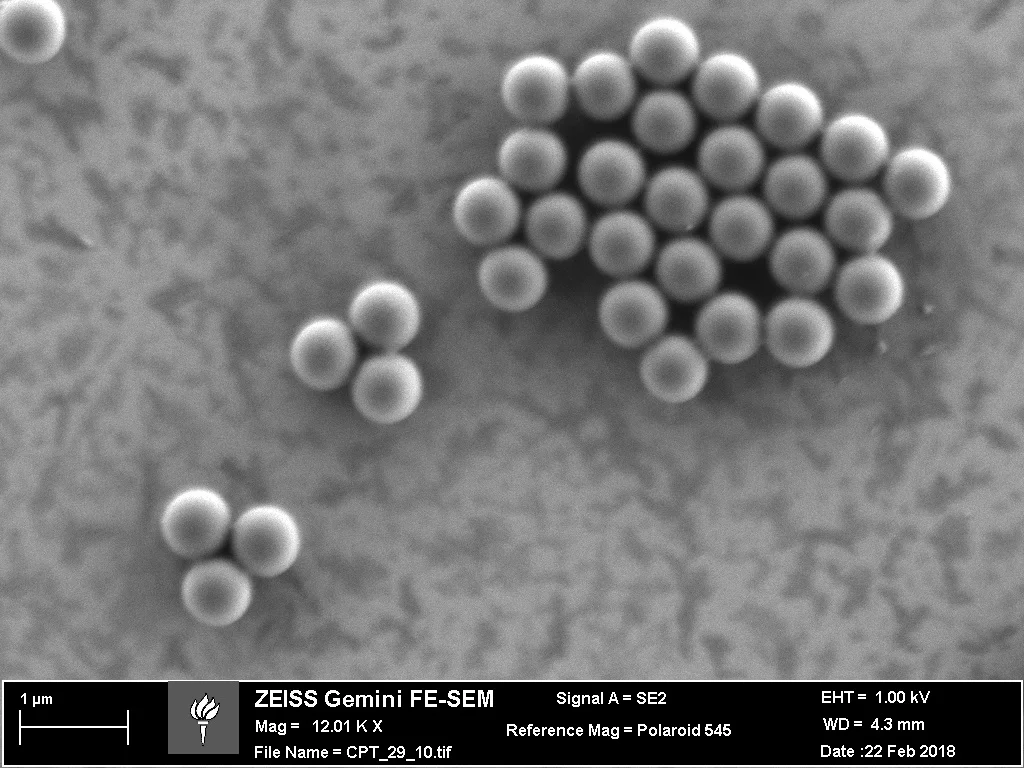
Sample Name: IP-01-15-CPT_29, IP-01-15-CPT_30
Description : Negative PS particles manufactured using surfactant-free emulsion polymerization.
Characteristics:
Diameter: 650 nm
ζ-potential: -47.9 mV, TBD
Recipe:
- An alumina column stoppered with cotton was used to remove inhibitor from the packaged styrene monomer. The filtered styrene monomer was refrigerated at 4 ℃ until ready to use.
- 350 mL of deionized water (by weight) was added into a 1000 mL triple-neck round-bottom flask.
- The round-bottom flask was then submerged into a silicone oil bath placed above a heating plate, where a mechanical stirrer and a condenser were attached to the flask.
- 35 mL of filtered styrene monomer were pipetted into the round-bottom flask, sealing the system with a rubber stopper.
- Mechanical stirring was engaged at 330 rpm, and the system was purged with high-purity nitrogen for approximately 30 minutes while the heating plate raised the temperature of the flask to 60 ℃, where it would remain for the duration of the polymerization.
- 350 mg of potassium peroxosulfate (KPS) were dissolved in 5 mL of deionized water, and added into the sealed system using a syringe after approximately 30 minutes after the addition of styrene.
- The polymerization was allowed to proceed for 18-20 hours, at which point the system was opened and heated to 90 ℃ for 90 minutes to evaporate unreacted monomer, and then allowed to cool all while stirring.
- The remaining radical initiator was cleaned out with three cycles of repeated centrifugation and resuspension in deionized water.

Sample Name(s): IP-01-15-CPT_9
Description : Positive PS particles manufactured using surfactant-free emulsion polymerization.
Characteristics:
Diameter: 700 nm
ζ-potential: +34.1 mV
Recipe:
An alumina column stoppered with cotton was used to remove inhibitor from the packaged styrene monomer. The filtered styrene monomer was refrigerated at 4 ℃ until ready to use.
350 mL of deionized water (by weight) was added into a 1000 mL triple-neck round-bottom flask.
The round-bottom flask was then submerged into a silicone oil bath placed above a heating plate, where a mechanical stirrer and a condenser were attached to the flask.
35 mL of filtered styrene monomer were pipetted into the round-bottom flask, sealing the system with a rubber stopper.
Mechanical stirring was engaged at 250 rpm, and the system was purged with high-purity nitrogen for approximately 30 minutes while the heating plate raised the temperature of the flask to 60 ℃, where it would remain for the duration of the polymerization.
350 mg of 2,2′-azobis(2-methylpropionamidine) dihydrochloride (AIBA) were dissolved in 5 mL of deionized water, and added into the sealed system using a syringe.
The polymerization was allowed to proceed for 18-20 hours, at which point the system was opened and heated to 90 ℃ for 90 minutes to evaporate unreacted monomer, and then allowed to cool all while stirring.
The remaining radical initiator was cleaned out with three cycles of repeated centrifugation and resuspension in deionized water.

Sample Name: IP-01-15-CPT_25
Description : Negative PS particles manufactured using surfactant-free emulsion polymerization.
Characteristics:
Diameter: 760 nm
ζ-potential: -45.0 mV
Recipe:
An alumina column stoppered with cotton was used to remove inhibitor from the packaged styrene monomer. The filtered styrene monomer was refrigerated at 4 ℃ until ready to use.
350 mL of deionized water (by weight) was added into a 1000 mL triple-neck round-bottom flask.
The round-bottom flask was then submerged into a silicone oil bath placed above a heating plate, where a mechanical stirrer and a condenser were attached to the flask.
35 mL of filtered styrene monomer were pipetted into the round-bottom flask, sealing the system with a rubber stopper.
Mechanical stirring was engaged at 330 rpm, and the system was purged with high-purity nitrogen while the heating plate raised the temperature of the flask to 60 ℃, where it would remain for the duration of the polymerization.
350 mg of potassium peroxosulfate (KPS) were dissolved in 5 mL of deionized water, and added into the sealed system using a syringe no later than 60 seconds from the addition of styrene.
The polymerization was allowed to proceed for 18-20 hours, at which point the system was opened and heated to 90 ℃ for 90 minutes to evaporate unreacted monomer, and then allowed to cool all while stirring.
The remaining radical initiator was cleaned out with three cycles of repeated centrifugation and resuspension in deionized water.
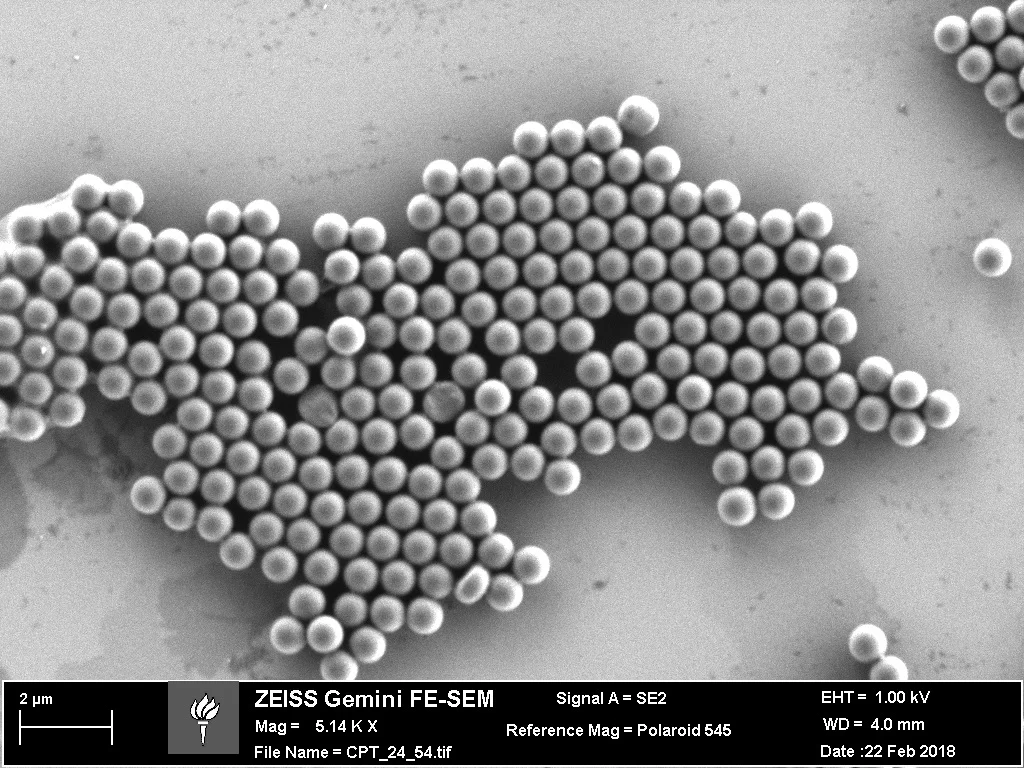
Sample Name: IP-01-15-CPT_24
Description : Positive PS particles manufactured using surfactant-free emulsion polymerization.
Characteristics:
Diameter: 800 nm
ζ-potential: +32.4 mV
Recipe:
- An alumina column stoppered with cotton was used to remove inhibitor from the packaged styrene monomer. The filtered styrene monomer was refrigerated at 4 ℃ until ready to use.
- 350 mL of deionized water (by weight) was added into a 1000 mL triple-neck round-bottom flask.
- The round-bottom flask was then submerged into a silicone oil bath placed above a heating plate, where a mechanical stirrer and a condenser were attached to the flask.
- 35 mL of filtered styrene monomer were pipetted into the round-bottom flask, sealing the system with a rubber stopper.
- Mechanical stirring was engaged at 330 rpm, and the system was purged with high-purity nitrogen while the heating plate raised the temperature of the flask to 60 ℃, where it would remain for the duration of the polymerization.
- 350 mg of 2,2′-azobis(2-methylpropionamidine) dihydrochloride (AIBA) were dissolved in 5 mL of deionized water, and added into the sealed system using a syringe no more than 60 seconds after the addition of styrene.
- The polymerization was allowed to proceed for 18-20 hours, at which point the system was opened and heated to 90 ℃ for 90 minutes to evaporate unreacted monomer, and then allowed to cool all while stirring.
- The remaining radical initiator was cleaned out with three cycles of repeated centrifugation and resuspension in deionized water.

Sample Name(s): IP-01-15-CPT_13
Description : Positive fluorescent PS particles manufactured using surfactant-free emulsion polymerization.
Characteristics:
Diameter: 800 nm
ζ-potential: +22.6 mV
Recipe:
An alumina column stoppered with cotton was used to remove inhibitor from the packaged styrene monomer. The filtered styrene monomer was refrigerated at 4 ℃ until ready to use.
350 mL of deionized water (by weight) was added into a 1000 mL triple-neck round-bottom flask.
The round-bottom flask was then submerged into a silicone oil bath placed above a heating plate, where a mechanical stirrer and a condenser were attached to the flask.
35 mL of filtered styrene monomer were pipetted into the round-bottom flask, sealing the system with a rubber stopper. This styrene was previously mixed with 0.25 mL of rhodamine-B-isothiocyanate/APS (coupled in 200-proof ethanol) before addition into the flask.
Mechanical stirring was engaged at 250 rpm, and the system was purged with high-purity nitrogen for approximately 30 minutes while the heating plate raised the temperature of the flask to 60 ℃, where it would remain for the duration of the polymerization.
350 mg of 2,2′-azobis(2-methylpropionamidine) dihydrochloride (AIBA) were dissolved in 5 mL of deionized water, and added into the sealed system using a syringe.
The polymerization was allowed to proceed for 18-20 hours, at which point the system was opened and heated to 90 ℃ for 90 minutes to evaporate unreacted monomer, and then allowed to cool all while stirring.
The remaining radical initiator was cleaned out with three cycles of repeated centrifugation and resuspension in deionized water.
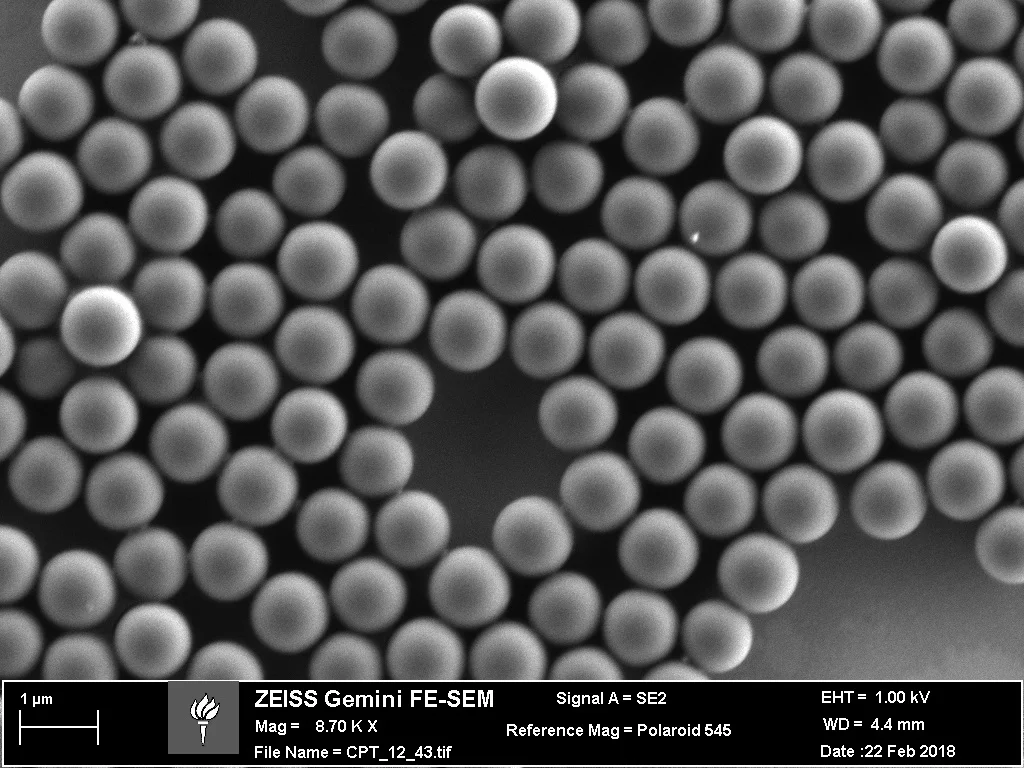
Sample Name: IP-01-15-CPT_12
Description : Negative PS particles manufactured using surfactant-free emulsion polymerization.
Characteristics:
Diameter: 1000 nm
ζ-potential: -49.3 mV
Recipe:
- An alumina column stoppered with cotton was used to remove inhibitor from the packaged styrene monomer. The filtered styrene monomer was refrigerated at 4 ℃ until ready to use.
- 350 mL of deionized water (by weight) was added into a 1000 mL triple-neck round-bottom flask.
- The round-bottom flask was then submerged into a silicone oil bath placed above a heating plate, where a mechanical stirrer and a condenser were attached to the flask.
- 35 mL of filtered styrene monomer were pipetted into the round-bottom flask, sealing the system with a rubber stopper.
- Mechanical stirring was engaged at 330 rpm, and the system was purged with high-purity nitrogen for approximately 5 minutes while the heating plate raised the temperature of the flask to 60 ℃, where it would remain for the duration of the polymerization.
- 350 mg of potassium peroxosulfate (KPS) were dissolved in 5 mL of deionized water, and added into the sealed system using a syringe.
- The polymerization was allowed to proceed for 18-20 hours, at which point the system was opened and heated to 90 ℃ for 90 minutes to evaporate unreacted monomer, and then allowed to cool all while stirring.
- The remaining radical initiator was cleaned out with three cycles of repeated centrifugation and resuspension in deionized water.

Sample Name: IP-01-15-CPT_19
Description : Negative PS particles manufactured using surfactant-free emulsion polymerization.
Characteristics:
Diameter: 1040 nm
ζ-potential: -49.8 mV
Recipe:
An alumina column stoppered with cotton was used to remove inhibitor from the packaged styrene monomer. The filtered styrene monomer was refrigerated at 4 ℃ until ready to use.
350 mL of deionized water (by weight) was added into a 1000 mL triple-neck round-bottom flask.
The round-bottom flask was then submerged into a silicone oil bath placed above a heating plate, where a mechanical stirrer and a condenser were attached to the flask.
35 mL of filtered styrene monomer were pipetted into the round-bottom flask, sealing the system with a rubber stopper.
Mechanical stirring was engaged at 330 rpm, and the system was purged with high-purity nitrogen for approximately 30 minutes while the heating plate raised the temperature of the flask to 60 ℃, where it would remain for the duration of the polymerization.
350 mg of potassium peroxosulfate (KPS) were dissolved in 5 mL of deionized water, and added into the sealed system using a syringe.
The polymerization was allowed to proceed for 18-20 hours, at which point the system was opened and heated to 90 ℃ for 90 minutes to evaporate unreacted monomer, and then allowed to cool all while stirring.
The remaining radical initiator was cleaned out with three cycles of repeated centrifugation and resuspension in deionized water.
Sample Name(s): IP-01-15-CPT_1, IP-01-15-CPT_6
Description : Positive PS particles manufactured using surfactant-free emulsion polymerization.
Characteristics:
Diameter: 440 nm
ζ-potential: +32.3 mV, +34.1 mV
Recipe: