
Colloidal Designers · Department of Chemistry · New York University
Matter, built
one particle at a time.
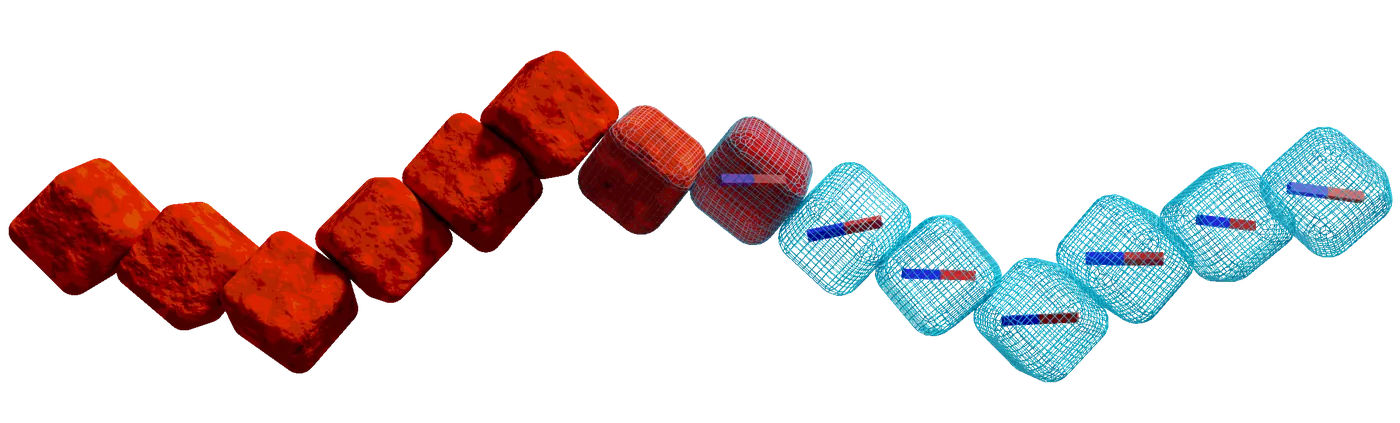
We synthesize particles with programmable shape, bonds and function, then teach them to assemble into crystals, machines and materials that do not exist in nature.
Latest
New from the lab
Research
Five ways we push colloids
Click a theme to open it and see the papers behind it.
Crystal collection
A field guide to ionic colloidal crystals
Opal gets its shimmer from silica beads packed into a crystal. Ours are built from plastic beads a few hundred times thinner than a hair, some positively charged and some negatively. In water they attract like the sodium and chloride ions in table salt and assemble into crystals of hundreds of thousands of beads, big enough to see under a microscope, so we can watch a crystal being built one particle at a time.
How to read a specimen
Names. Each crystal is named after the atomic crystal whose pattern it copies: in a CsCl-like crystal, our beads sit where cesium and chloride ions sit in cesium chloride.
Photos. A light microscope shows the crystals in water; an electron microscope shows dried crystals in enough detail to count the beads.
Unit cell. The smallest group of beads that repeats to fill the whole crystal, like one tile of a tiled floor.
Diffraction. The pattern of peaks a crystal scatters light or X-rays into, a fingerprint of its structure.
Scale. 1 µm is a thousandth of a millimeter; a hair is about 80 µm wide.
Negative particlePositive particle
Publications
On the cover
Papers
Where we publishBy journal and publisher
People
The group
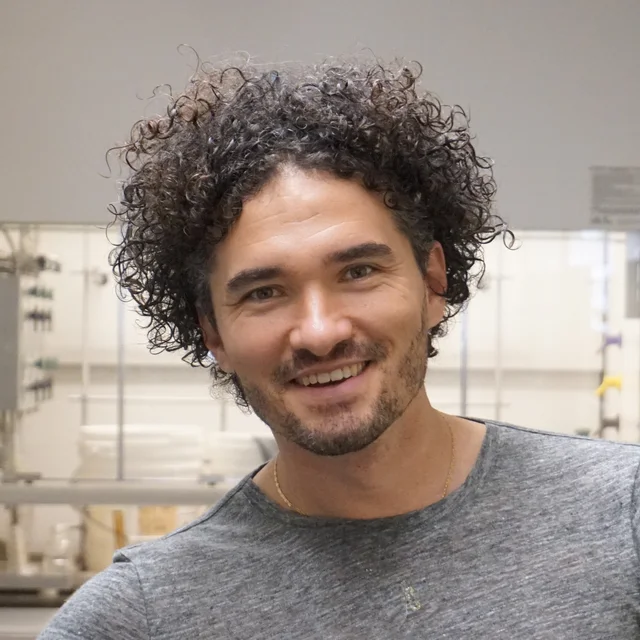
Stefano Sacanna
Professor of Chemistry, New York University
Distinguished Professor, POSTECH (2026–2027) · Debye Visiting Chair, Utrecht University (2026)
Stefano Sacanna trained as an industrial chemist at the University of Bologna and earned his PhD cum laude in physical and colloid chemistry at Utrecht University. He came to New York in 2008 as an NWO Rubicon fellow at NYU's Center for Soft Matter Research, and joined the NYU Chemistry faculty in 2013.
His group designs colloidal particles with programmable shape, surface chemistry and function, and uses them as building blocks for materials that do not exist in nature: lock-and-key colloids, patchy particles made by colloidal fusion, colloidal diamond, ionic colloidal crystals and inorganic cell mimics. His work has been recognized with the NSF CAREER Award, a Human Frontier Science Program Young Investigator award, the APS Early Career Award for Soft Matter Research and a Falling Walls prize.
Path & awardsCareer and recognition
Path
- 2003Laurea in Industrial ChemistryUniversity of Bologna
- 2007PhD cum laude, Physical & Colloid ChemistryUtrecht University
- 2008Postdoctoral Fellow, Center for Soft Matter ResearchNew York University
- 2013Assistant Professor of ChemistryNew York University
- 2019Associate Professor of ChemistryNew York University
- 2019Visiting Associate Professor of PhysicsUniversity of Chicago
- 2021Professor of ChemistryNew York University
- 2026Debye Visiting ChairUtrecht University
- 2026Distinguished Professor, Global POSTECH ScholarPOSTECH, South Korea
Awards
- 2022Falling Walls Winner, Life Sciences
- 2020APS Early Career Award for Soft Matter Research
- 2018Human Frontier Science Program, Young Investigator
- 2017NSF CAREER Award
- 2008NWO Rubicon Fellowship
Join us
Make particles nobody has made before.
We look for curious chemists, physicists and engineers who like to get their hands wet. If you want to join as a PhD student, postdoc or visiting researcher, send a CV and a short note on what you would like to build.